

What is an impacted tooth? This is a question we frequently hear from patients who feel a dull ache at the back of their jaw or notice a tooth that simply refuses to emerge. At Mavidenta, our 7,000-square-meter specialist facility in Istanbul, we address hundreds of these cases every month using precise 3D imaging to map the exact position of the hidden tooth.
Whether it is a wisdom tooth trapped under the gum or a canine that has lost its way, understanding the risks is essential for your long-term oral health. If you are experiencing jaw pain or visible crowding, you can send us your X-ray for a free online consultation via WhatsApp at +905534843641.
What Is an Impacted Tooth? (Definition & Meaning)
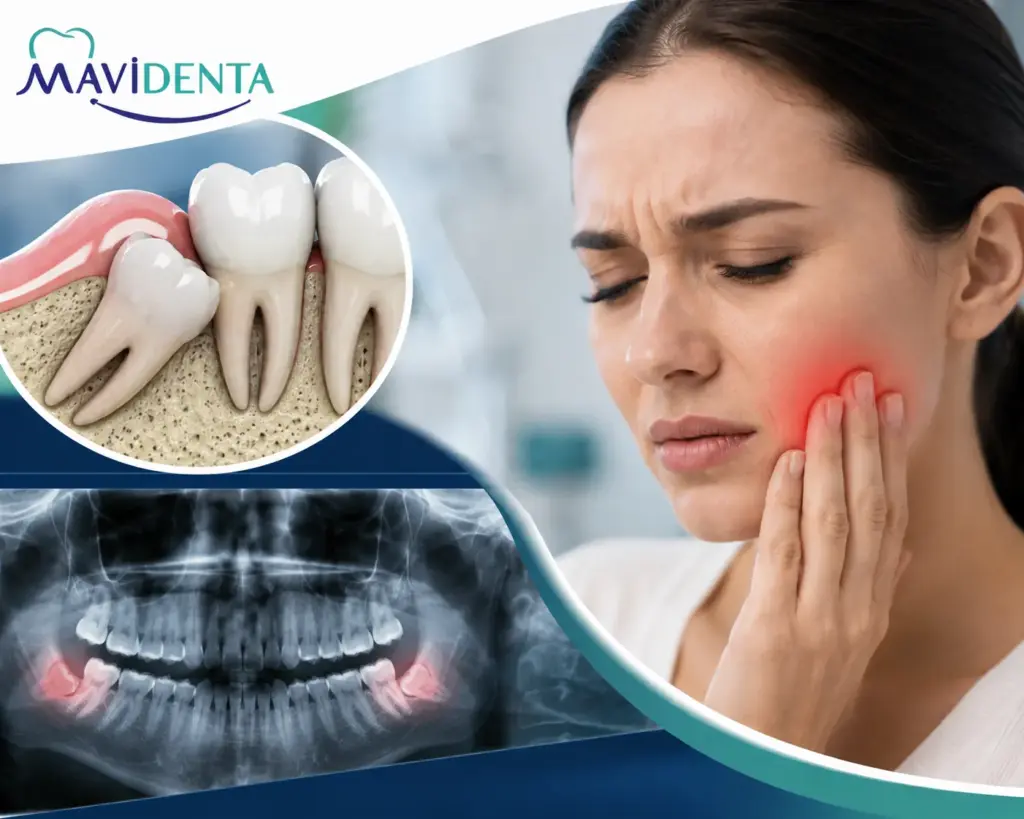
An impacted tooth refers to a tooth that has failed to erupt through the gum line into its proper functional position. Instead of growing straight, it remains stuck in the bone or gum tissue.
This happens most often with third molars (wisdom teeth) and maxillary canines. While some patients live years without knowing they have one, a dental impaction can eventually trigger infection or damage the roots of healthy neighbouring teeth.
Impacted Tooth Signs and Symptoms
Many patients ask me, “What is an impacted tooth and what does it look like?” Often, you cannot see them at all. However, you might notice a small “bump” on the gum or a gap where a permanent tooth should have appeared years ago.
For the treatment pathway, see our guide to [dental treatments at Mavidenta].
What Does an Impacted Tooth Feel Like?
The sensation varies for each patient. However, you might experience:
- A throbbing ache in the back of the jaw.
- Tenderness or bleeding in the gums at the very end of the dental arch.
- Persistent bad breath or a strange taste, which often indicates an infection (pericoronitis) around a partially erupted tooth.
- Difficulty opening your mouth fully.
What Causes an Impacted Tooth?
There isn’t just one reason why teeth get stuck. Our oral surgeon, Dr. Ahmet Yıldız, who has over 15 years of experience in complex extractions, often notes that jaw anatomy is the primary factor. There are other reasons as well, including:
Lack of Space in the Jaw
Modern human jaws are often too small to accommodate 32 teeth. This is the most common reason for wisdom tooth impaction.
Overcrowding of Teeth
If your existing teeth are shifted or naturally large, there is simply no “window” for the new tooth to emerge.
Abnormal Tooth Position
Sometimes teeth grow sideways (horizontally) or at a sharp angle. They hit the root of the next tooth and stop.
Genetics
If your parents required dental implant surgery, there is a higher statistical likelihood that you or your children will too.
Delayed Baby Tooth Loss
If a primary tooth doesn’t fall out on time, the permanent tooth underneath may divert its path or become trapped.
Dense Jawbone
In some cases, the bone tissue is exceptionally thick, making it physically impossible for the tooth to break through without surgical help.
What Are the Different Types of Impacted Teeth?
We can categorize the different types of impacted teeth based on position or tissue coverage. We’ll give you an overview of both.
Based on Position
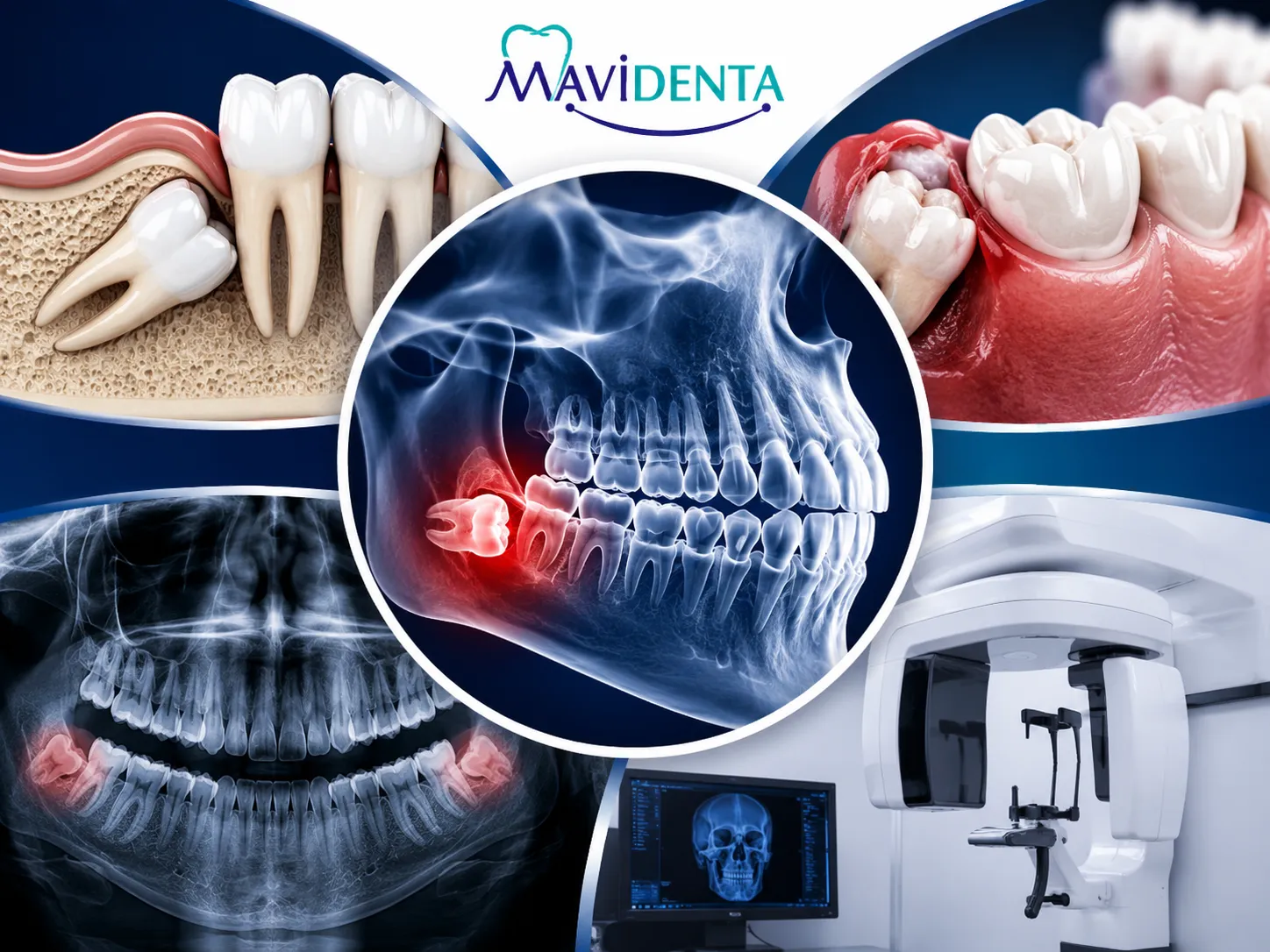
- Horizontal Impaction: The tooth is lying completely on its side. This is the most difficult to remove as it often pushes directly into the roots of the second molar.
- Vertical Impaction: The tooth is upright but stuck beneath the bone.
- Mesial & Distal: The tooth is angled either toward the front of the mouth (mesial) or the back (distal).
Based on Tissue Coverage
- Soft Tissue Impaction: The tooth has cleared the bone but is still covered by a thick layer of gum.
- Partial Bony Impaction: Part of the tooth is still encased in the jawbone.
- Complete Bony Impaction: The tooth is entirely encased in the bone, requiring a more complex surgical approach.
What Happens If You Leave an Impacted Tooth Untreated?
Ignoring tooth impaction is risky. Over time, it can cause these common complications:
- Cyst Formation: A sac of fluid can form around the trapped tooth, which can hollow out the jawbone and damage nerves.
- Resorption: The impacted tooth can “eat away” the roots of the healthy tooth next to it.
- Chronic Infection: Partially erupted teeth are impossible to clean, leading to repeated rounds of painful gum infections.
what Is Restorative Dental Treatment and Who Is It for? A Guide for UK Patients
When Should You See a Dentist for an Impacted Tooth?
You should book a consultation if you feel pressure in your jaw or notice your front teeth starting to crowd unexpectedly. At Mavidenta, we use 3D Tomography (CBCT) to see exactly where the tooth is located relative to your facial nerves. This technology ensures our surgery involves zero guesswork.
How Are Impacted Teeth Treated?
Our approach depends on the tooth’s importance. A wisdom tooth is usually removed, whereas an impacted canine is often “rescued.” There are a few ways for the treatment, including:
Monitoring (If No Symptoms)
If the tooth is completely buried, unlikely to move, and shows no signs of cysts, we may choose to monitor it with annual X-rays.
Surgical Extraction
This is the standard for wisdom teeth. Dr. Ahmet Yıldız performs this procedure under local anaesthesia or sedation, ensuring the patient feels nothing but slight pressure.
Orthodontic Exposure (For Impacted Canines)
For younger patients, we often want to save the tooth. Dr. Murat Demir, our orthodontist, works with our surgeons to “uncover” the tooth and use braces to gently pull it into the correct position over several months.
Dental Impaction Surgery Procedure
- Sedation/Anaesthesia: Ensuring total comfort.
- Incision: A small opening in the gum.
- Bone Removal: If necessary, a small amount of bone is cleared.
- Sectioning: The tooth is often cut into smaller pieces for easier, less traumatic removal.
- Suturing: The site is closed with dissolvable stitches.
Cost of Impacted Tooth Treatment
The cost of dental impaction surgery in the UK can be prohibitive, especially if you require a private specialist. In Istanbul, at Mavidenta, we offer the same Swiss and German surgical standards at a fraction of the price.
Here’s the price difference in the UK vs. Turkey:
| Treatment Type | UK Average Cost (Private) | Mavidenta (Turkey) Price |
| Simple Extraction | £150 – £300 | £40 – £80 |
| Complex Surgical Impaction | £450 – £900 | £120 – £250 |
| Sedation (IV) | £250 – £400 | Included/Low Fee |
| 3D CT Scan | £150 – £250 | Included |
Is It Safe to Have Surgery in Turkey?
Safety is the result of specialisation. At Mavidenta, we have a 97.8% success rate across all surgical procedures. We use only Swiss (Straumann) or German (Medigma) materials. Our facility is a 7,000 square meter dedicated dental hospital, not a small clinic. We provide a lifetime guarantee on implants and a 20-year warranty on crowns, backed by a clinical team with over 20 years of individual experience, such as Dr. Necat Aslan (PhD in Prosthodontics).
From First Message to Final Smile: A Mavidenta Patient Story
Nora, a 43-year-old teacher from Manchester, had been suffering from a “dull, heavy pressure” in her lower jaw for two years. Her local dentist in the UK told her the wisdom tooth impaction was too close to the nerve and referred her to a specialist with an 8-month waiting list and a £1,200 quote.
Contact & Assessment Nora sent a message to Mavidenta via WhatsApp. She shared her panoramic X-ray. Dr. Ahmet Yıldız reviewed it the same day. He confirmed it was a complete bony impaction but noted that using our 3D imaging, we could navigate safely around the nerve.
Arrival & Treatment Nora arrived at Istanbul Airport and was met by a Mavidenta VIP transfer. “I was nervous about the ‘surgery’ part,” Nora admitted during her first face-to-face consultation. Dr. Ahmet sat with her, showed her the 3D map of her jaw, and explained how the tooth would be sectioned to avoid nerve pressure. This honest, technical explanation resolved her doubt.
Recovery & Follow-Up: The procedure took 45 minutes under IV sedation. Nora spent the next two days exploring Istanbul’s historic sites (with a bit of swelling, but no pain). Before her flight back, he had a final check-up with Dr. Özlem Yalçın to ensure the site was healing perfectly.
“I expected it to be an ordeal, but it was just a professional medical procedure in a very nice building,” Nora said. She returned to Manchester pain-free, having spent less on the treatment, flights, and a 5-star hotel than the single surgery quote back home.
Why Choose Mavidenta for Impacted Tooth Treatment?
- 7,000 sq.m Specialist Facility: One of the largest and most advanced in Turkey.
- Specialist Team: You are treated by surgeons like Dr. Ahmet Yıldız and Dr. Selin Kaya (Periodontist), not generalists.
- Advanced Imaging: We use AI-integrated 3D scans for every impaction case.
- VIP Service: We handle your hotel and airport transfers and provide an in-clinic translator.
- Total Transparency: No hidden fees. The price we quote via WhatsApp is what you pay.
Conclusion: What to Do If You Have an Impacted Tooth
An impacted tooth is more than just a hidden nuisance; it is a potential threat to your oral health. Whether you need a complex surgical extraction or orthodontic exposure, the team at Mavidenta has the experience and technology to help.
Don’t wait for an infection to become an emergency. Contact us today at +905534843641 for a free clinical assessment and a transparent quote. We are ready to help you rediscover a pain-free smile.
wisdom Teeth Removal In Turkey Guide
FAQs About Impacted Teeth
Do all impacted teeth need to be removed?
Not always. According to research in the Journal of Oral and Maxillofacial Surgery (2021), asymptomatic impacted teeth that are completely encased in bone can sometimes be left alone. However, they must be monitored annually. If the tooth is partially emerged, removal is usually required to prevent decay and infection.
How long does impacted tooth surgery take?
A single tooth extraction usually takes between 20 and 45 minutes. The complexity, such as whether it is a soft tissue or a complete bony impaction, determines the exact time. At Mavidenta, we prioritise precision over speed to ensure the surrounding bone is preserved.
Can an impacted tooth cause headaches?
Yes. Dental impaction often causes referred pain. The pressure on the surrounding nerves and the inflammation of the jaw muscles can lead to chronic tension headaches or pain that feels like an earache.
What is the recovery time?
Most patients return to work within 2–3 days. Initial healing takes about a week, which is when we remove any non-dissolvable sutures. We provide all necessary medications and a detailed aftercare plan.
Will I be awake during the surgery?
We offer local anaesthesia as a standard precaution, but many of our international patients prefer IV sedation. This allows you to remain conscious but in a state of total relaxation, with no memory of the procedure.