

Receding gums stages often progress so slowly that many patients do not notice the damage until their tooth roots are exposed. At Mavidenta, our doctors believe that early intervention is the difference between a simple deep clean and a complex surgical graft.
At Mavidenta, we operate a 7,000 square meter specialist facility in Istanbul where we have helped over 15,000 patients regain their oral health. If you are concerned about your gum line, you can message us on WhatsApp +905534843641 for a free clinical assessment of your photos or X-rays.
What Is Gum Recession?
Gum recession, or gingival recession, occurs when the margin of the gum tissue surrounding the teeth wears away or pulls back. This process exposes more of the tooth, or even the tooth root.
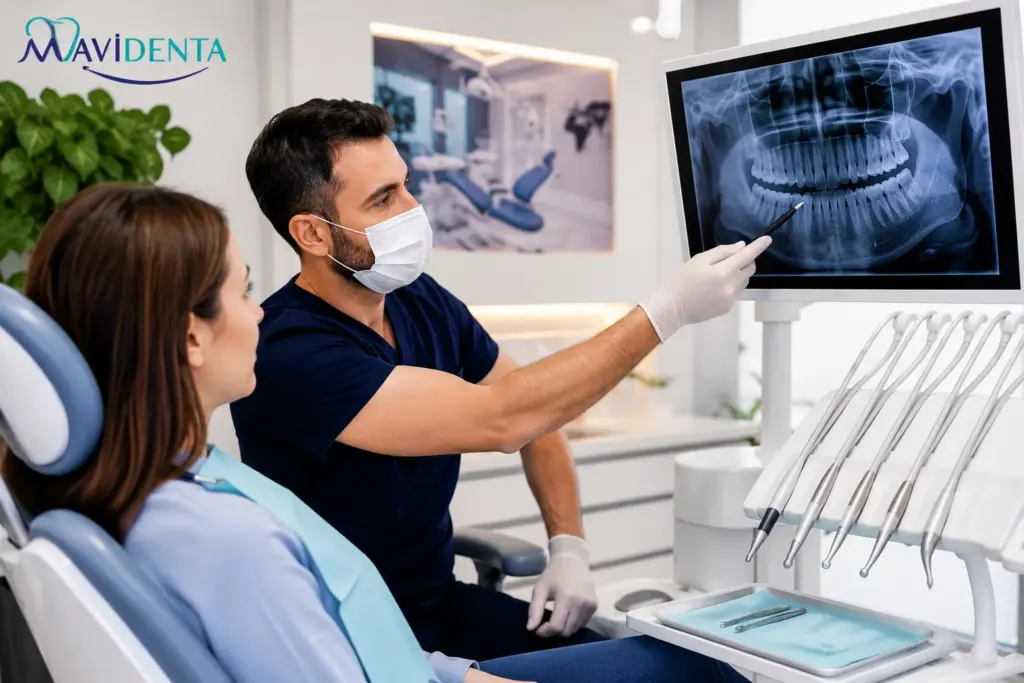
Clinical diagnosis relies on pocket depth measurement. During an examination, Dr. Selin Kaya, our periodontist with 15+ years of experience, uses a calibrated probe to measure the space between the tooth and the gum. Healthy pockets measure 1–3mm; anything deeper indicates the onset of periodontal disease.
For the treatment pathway, see our guide to [periodontal treatment in Turkey].
The 4 Stages of Gum Recession Explained
Understanding the receding gums stages helps determine the urgency of your treatment. At Mavidenta, we categorise these based on clinical attachment loss and bone involvement. Here’s a quick comparison between different stages:
Stage |
Clinical Name |
Pocket Depth |
Visual Signs |
|---|---|---|---|
| Stage 1 | Gingivitis | 3–4 mm | Redness, occasional bleeding when brushing. |
| Stage 2 | Early Periodontitis | 4–5 mm | Teeth look longer; minor root sensitivity. |
| Stage 3 | Moderate Periodontitis | 5–6 mm | Visible gaps (black triangles); root exposure. |
| Stage 4 | Advanced Periodontitis | 7+ mm | Tooth mobility, significant bone loss, and risk of loss. |
Stage 1 — Mild: Early Gum Line Changes
In this stage, the attachment between the gum and the tooth begins to weaken. You might notice “pink toothbrush” syndrome, where gums bleed slightly. This is the only stage where the damage is often reversible through professional scaling and root planing.
Stage 2 — Moderate: Root Surface Exposure Begins
As the pockets deepen to 4–5mm, the cementum (the soft covering of the root) becomes exposed. Because cementum lacks the hard protection of enamel, you will likely feel a sharp “zing” when drinking cold water.
Stage 3 — Severe: Significant Bone and Tissue Loss
By Stage 3, the infection has reached the underlying bone. You will notice “black triangles” appearing between your teeth because the papilla (the gum peak between teeth) has receded. According to the Journal of Periodontology (2021), untreated Stage 3 recession leads to a 50% higher risk of tooth loss within five years.
Stage 4 — Advanced: Tooth Mobility and Extraction Risk
This is a clinical emergency. The teeth may feel loose or shift when you bite down. At this stage, Dr. Ahmet Yıldız, our oral surgeon, often collaborates with our periodontists to determine if a tooth can be saved or if a dental implant is a more predictable long-term solution.
What Causes Gums to Recede?
While poor oral hygiene is a primary driver, it is not the only cause. Many of my UK patients have excellent hygiene but suffer from recession due to:
- Aggressive Brushing: Using a hard-bristled brush or too much pressure.
- Genetics: Naturally thin gum biotype (common in 15% of the population).
- Bruxism: Chronic teeth grinding puts immense pressure on the ligament.
- Orthodontics: Moving teeth too quickly or outside the bone envelope.
Can Receding Gums Grow Back?
We must be honest with you, gum tissue does not grow back naturally. Once the gingival margin has receded, the body cannot regenerate that specific soft tissue or the lost alveolar bone on its own.
However, we can “fix” the appearance and function. Through gum grafting, we take a small amount of tissue (usually from the palate) and microsurgically attach it to the recessed area. This covers the root and prevents further decay.
how To Get Healthy Teeth And Gums Naturally Simple Guide
Treatment Options by Stage
Here are the different treatments that can be used for different receding gums stages:
Stage |
Recommended Treatment |
Surgery Required? |
Mavidenta Specialist |
|---|---|---|---|
| Stage 1 | Scaling & Root Planing | No | Dental Hygienist |
| Stage 2 | Deep Cleaning + Laser Therapy | No | Dr. Selin Kaya |
| Stage 3 | Connective Tissue Grafting | Yes | Dr. Selin Kaya |
| Stage 4 | Bone Grafting / All-on-4 Implants | Yes | Dr. Ahmet Yıldız |
Is It Safe to Get Gum Treatment in Turkey?
Safety in dentistry comes from specialization. At Mavidenta, we do not use “general” dentists for surgical cases. Your gum treatment is handled by Dr. Selin Kaya, a dedicated periodontist. We also use Swiss-made Straumann materials for all regenerative procedures, ensuring the highest biocompatibility.
Our clinic maintains a 97.8% success rate for surgical interventions. We provide a lifetime guarantee on implants and a 20-year warranty on crowns, backed by a vast facility that remains open for your follow-up care years after your initial visit.
From First Message to Final Smile: A Mavidenta Patient Story
Mark, a 48-year-old writer from Edinburgh, contacted us via WhatsApp after his local dentist mentioned he might lose two lower incisors due to Stage 3 recession. He was worried about the “long tooth” look and the constant sensitivity to his morning coffee.
CONTACT & ASSESSMENT: Mark sent high-resolution photos and a recent X-ray. Dr. Selin Kaya reviewed them and identified that while he had bone loss, his roots were still viable for a graft.
ARRIVAL: We arranged his VIP transfer from Istanbul Airport. Mark stayed at our partner hotel, five minutes from the clinic. During his first in-person consultation, he felt a moment of doubt. “I was worried about the pain of taking tissue from the roof of my mouth,” he told us. Dr. Selin explained our microsurgical approach, which uses smaller incisions to minimize discomfort.
TREATMENT: Under local anaesthetic, Dr. Selin performed a connective tissue graft. The procedure took 90 minutes. Mark spent the next two days exploring the historic Sultanahmet area, following our “soft food” protocol.
RECOVERY & RESULT: Four months later, Mark sent us a photo from Edinburgh. The “black triangles” were gone, and the gum line was stable. “I can drink a cold beer without wincing for the first time in three years,” Mark wrote in his follow-up email.
Getting Gum Treatment Cost in Istanbul vs. the UK
The primary reason patients travel to Mavidenta is the access to specialists at a fraction of UK private costs.
Here’s a quick on the price difference for various treatments in the UK vs. Turkey:
Procedure |
UK Private Price |
Mavidenta Price |
Your Savings |
|---|---|---|---|
| Scaling & Root Planing | £350 | £110 | 68% |
| Gum Graft (per area) | £900 | £320 | 64% |
| Full Mouth Detox | £1,200 | £400 | 66% |
| Laser Gum Therapy | £600 | £200 | 66% |
Prices are estimates; final quotes require a clinical evaluation.
Read more about [cosmetic Dentistry for Receding Gums Treatment Guide] before choosing the right option.
Conclusion
Understanding the receding gums stages is not just an educational concept. It is the foundation of a decision that directly affects whether you keep your teeth for life or begin losing them within five years.
The progression from Stage 1 to Stage 4 is not inevitable. It is the result of delayed action, whether due to NHS waiting times, the cost of UK private periodontal care, or simply not recognising the early warning signs until they become impossible to ignore.
That window still exists for most patients reading this. But it does not stay open indefinitely. If you have noticed bleeding gums, increased tooth sensitivity, a lengthening gum line, or black triangles appearing between your teeth, do not wait for your next NHS appointment. Send your photographs or X-rays to our team via WhatsApp at +905534843641 for a free assessment by a dedicated periodontist.
Frequently Asked Questions
How fast do gums recede?
In healthy individuals with minor trauma, recession may take a decade to show. However, if active periodontitis is present, gums can pull back by 1–2mm in just a few months. Regular check-ups are vital to catch this.
What are the 4 stages of gum disease?
The four stages are Gingivitis (inflammation), Early Periodontitis (pocket formation), Moderate Periodontitis (bone loss starts), and Advanced Periodontitis (tooth mobility). Treatment becomes significantly more invasive after Stage 2.
Can I get a receding gums fix in the UK on the NHS?
The NHS typically covers “clinically necessary” cleaning (Scaling). However, cosmetic gum grafting to cover exposed roots is often considered elective and is rarely available, forcing patients to seek expensive private care or travel abroad.
What are the first signs of receding gums?
Increased sensitivity to hot and cold is usually the first sign. You may also notice a small “notch” at the top of the tooth near the gum line, or your teeth may simply look slightly more yellow near the base.
Does gum grafting at Mavidenta hurt?
We use advanced local anaesthetics and microsurgical pigments. Most patients report a sensation of “tightness” for 48 hours but rarely describe it as acute pain. We provide all necessary medications and 24/7 WhatsApp support during your recovery.
Take the first step toward saving your smile. If you notice your gums changing, do not wait for the bone loss of Stage 3. Contact our specialist team today for a transparent, no-obligation consultation.
WhatsApp: +905534843641
Location: Mavidenta Clinic, Istanbul, Turkey