

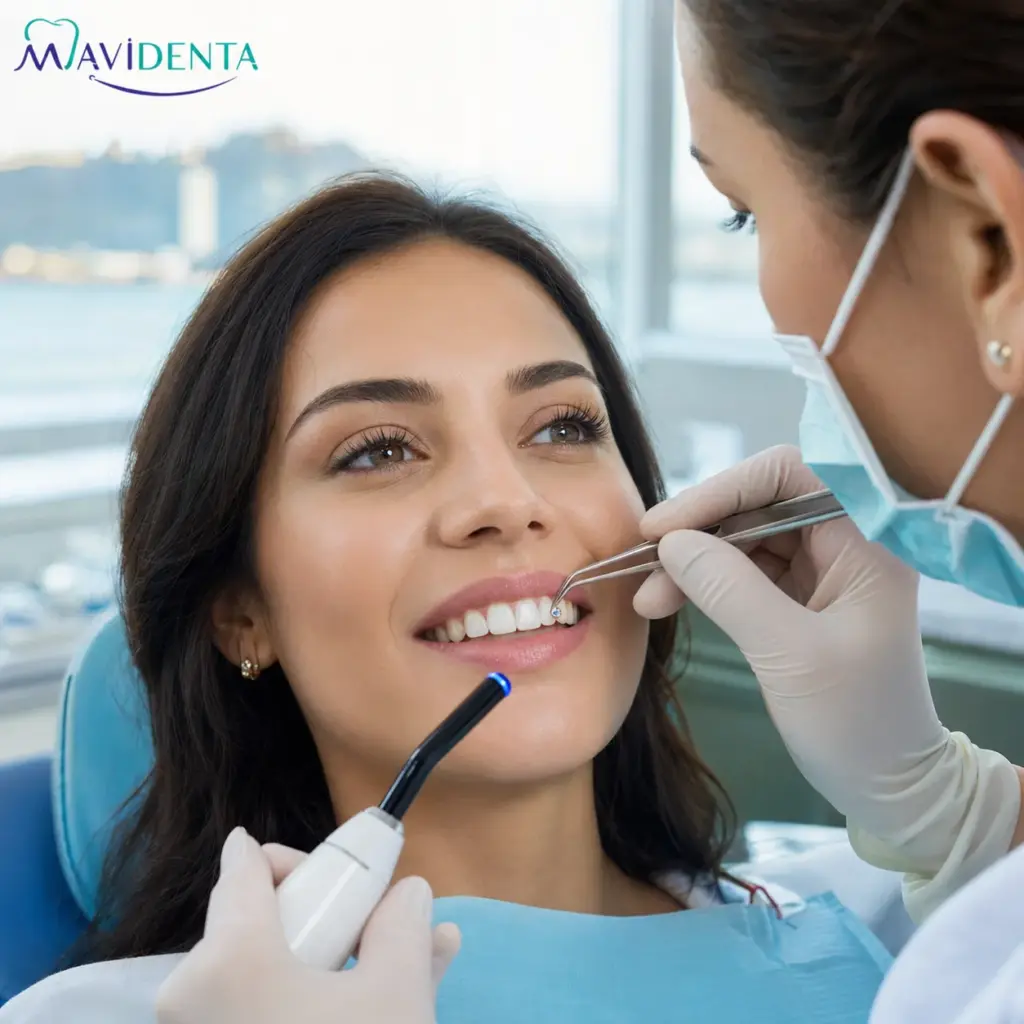
A dental diamond is a subtle yet striking way to add personal flair to your smile without undergoing invasive surgery. At Mavidenta, we have seen a significant rise in patients from London, Manchester, and Dubai requesting a tooth gem to complement their new veneers. We view this not just as a trend, but as a precise cosmetic procedure.
If you are visiting our 7,000-square-meter facility in Istanbul for a Hollywood Smile or a simple cleaning, adding a tooth jewel is a safe, reversible way to enhance your appearance.
[Book your free consultation via WhatsApp +905534843641 to discuss your smile design.]
What Is a Dental Diamond?
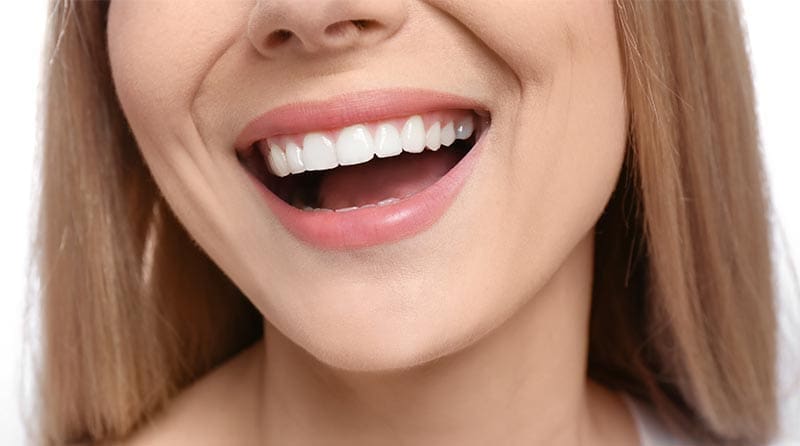
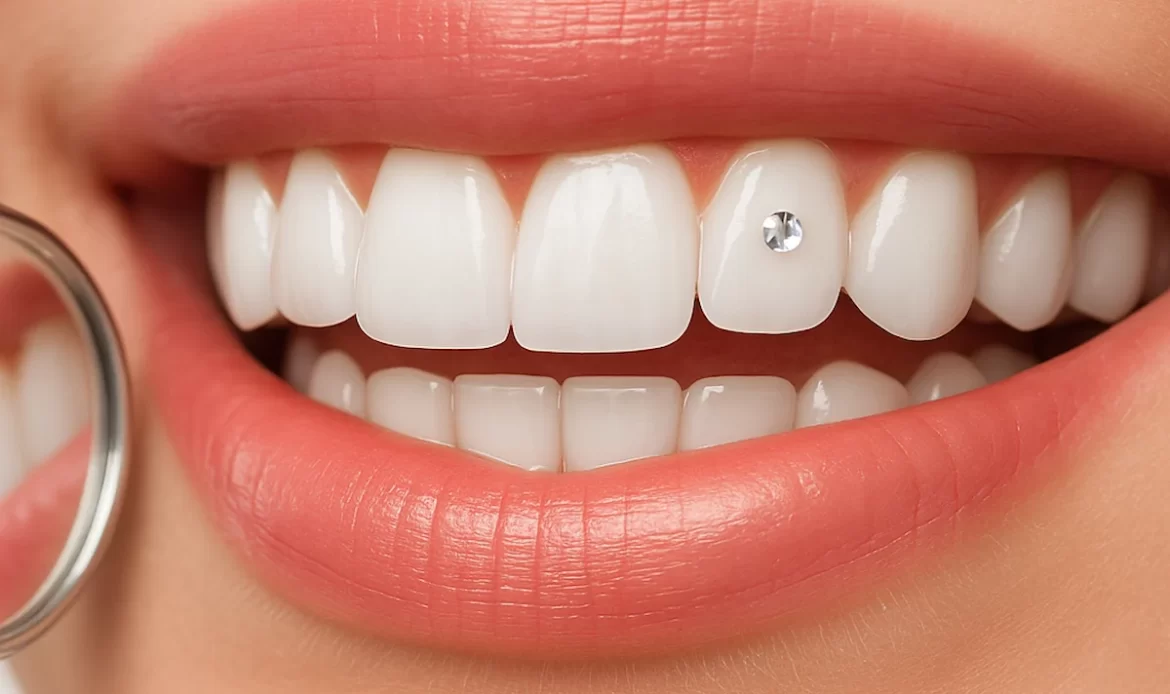
A dental diamond or tooth gem is a small, high-quality crystal, gold charm, or genuine precious stone bonded to the surface of a natural tooth. Unlike traditional jewellery, these are specifically designed for oral environments. We use lead-free Swarovski dental crystals or lab-grown diamonds that resist the acidic nature of saliva and food.
Dr. Özlem Yalçın, our cosmetic dentist with over 15 years of experience, notes that the most popular choice is the 1.8mm or 2mm clear crystal. It provides a “sparkle” effect that mimics the refraction of light in a real diamond without the heavy price tag of a natural stone.
Is a Dental Diamond Permanent?
One of the most frequent questions we hear in the clinic is whether a dental diamond is permanent. The answer is no, but it is “semi-permanent.” When we apply a dental crystal tooth, we use a professional-grade bonding agent, the same material we use to attach orthodontic braces.
If maintained well, the stone can stay in place for several years. However, if you decide you no longer want the “tooth bling,” a dentist can remove it in under five minutes with no lasting effect on your enamel.
For the treatment pathway, see our guide to [Hollywood Smile in Turkey].
Who Can Get a Dental Diamond?
Clinically, almost anyone with healthy, natural teeth can receive a dental diamond application. However, there are three main criteria for it:
- Natural Enamel: The bonding agent works best on natural tooth structure. While we can bond to veneers or crowns, the bond strength is slightly lower.
- Oral Health: We do not apply gems to teeth with active decay or gum disease.
- Placement: The stone should be placed on a tooth that isn’t subjected to heavy biting forces, usually the lateral incisor or canine.
How Is a Tooth Gem Applied? (Step by Step)
The process is entirely non-invasive. There is no drilling, no pain, and no anaesthesia required.
- Step 1: Cleaning: We professionally clean the tooth surface to remove plaque.
- Step 2: Etching: A medical-grade phosphoric acid gel is applied for 20 seconds to create a microscopic surface for the bond to grip.
- Step 3: Bonding: A small amount of dental bonding adhesive (flowable composite) is placed on the tooth.
- Step 4: Setting: The stone is placed into the resin. We then use a UV curing light to harden the adhesive instantly.
- Step 5: Finishing: We wipe away any excess resin, leaving a smooth finish that won’t irritate your lip.
Are There Any Risks?
Being honest with our patients is paramount. While tooth jewellery is safe, risks arise when you use “DIY kits” or visit non-dental salons. The primary risks of improper application include:
- Enamel Damage: Using non-dental glues can permanently stain or erode enamel.
- Aspiration: If the stone isn’t bonded professionally, it can fall off and be swallowed or inhaled.
- Plaque Accumulation: If you do not brush thoroughly around the gem, bacteria can gather, leading to a small cavity underneath or around the stone.
Our doctors note that patients who follow a standard hygiene routine face zero long-term issues.
Dental Diamond Cost: UK vs. Turkey
Patients often travel to Mavidenta from the UK to combine cosmetic work with savings. While a tooth gem UK price might seem low, it is often performed in a beauty salon rather than a sterile clinical environment.
Here’s the price difference between Turkey and the UK:
Location |
Treatment Type |
Estimated Price |
|---|---|---|
| United Kingdom (Private Clinic) | Swarovski Crystal + Application | £80 – £180 |
| United Kingdom (Beauty Salon) | Non-medical Gem | £40 – £70 |
| Mavidenta Istanbul | Swarovski/High-End Crystal | £40 – £60 |
| Mavidenta Istanbul | Genuine 0.01ct Diamond | £150 – £250 |
Note that applying a dental diamond at a beauty salon is not recommended by doctors.
From First Message to Final Smile: A Mavidenta Patient Story
Sarah, a 28-year-old marketing manager from Edinburgh, contacted us via WhatsApp after seeing our cosmetic work on Instagram. She was initially interested in invisible aligners, but during her online consultation with Dr. Murat Demir, she mentioned she wanted a “finishing touch” for her smile.
Upon arrival at Istanbul airport, Sarah was met by our VIP transfer team and taken to a 5-star hotel nearby. The next morning, she met Dr. Özlem Yalçın for her assessment. Sarah had a slight moment of doubt; she worried the dental diamond would look “tacky” or feel bulky against her lip. Dr. Yalçın showed her the 1.8mm Swarovski tooth crystal, explaining that its low profile makes it virtually unnoticeable to the tongue.
“I was so nervous it would ruin my tooth enamel,” Sarah told our translator. “But seeing the clinical setup and the fact that a specialist doctor was doing it made me feel completely safe.”
The application took 20 minutes at the end of her hygiene appointment. During her follow-up 24 hours later, Sarah was beaming. “It catches the light just enough that people notice something different, but it’s so subtle and elegant. I love it.” She returned to Edinburgh the following day, provided with a 20-year warranty on her other dental work and a lifetime of support for her new smile.
Which Types of Stones Are Used?
There are a few types of stones that can be used as a dental diamond, and the choice is completely yours, based on the final look that you want. Here is a quick comparison between the main types:
Stone Type |
Characteristics |
Durability |
|---|---|---|
| Swarovski Crystal | High lead-free brilliance, flat back. | Excellent (1-3 years) |
| Cubic Zirconia | Durable, diamond-mimic, affordable. | Good (1-2 years) |
| 18k Gold Charms | Hearts, stars, or logos. | Excellent (2-5 years) |
| Genuine Diamond | A real precious stone needs a special setting. | Variable (requires deep bond) |
Why Choose Mavidenta for Cosmetic Add-ons?
At Mavidenta, we don’t treat a tooth diamond as a trivial accessory. We apply the same clinical rigor to a crystal as we do to a full-mouth rehabilitation performed by Dr. Necat Aslan (DDS, PhD).
We use only Swiss and German materials, ensuring that the adhesives are biocompatible. Because we see over 1,500 UK patients annually, we understand the aesthetic preferences of our international clientele. When you choose Mavidenta, you receive a lifetime guarantee on implants and a commitment to safety that smaller clinics cannot match.
Conclusion
A dental diamond is one of the few aesthetic additions to your smile that carries virtually no clinical risk when applied correctly, requires no recovery time, and can be reversed completely if your tastes change.
If you are already planning a visit to Mavidenta for veneers, implants, or a smile makeover, adding a tooth gem to your appointment takes nothing more than a conversation with Dr. Yalçın during your consultation. If you are considering it as a standalone procedure, our coordinators are available via WhatsApp at +905534843641 to answer any questions and confirm your suitability.
The best smiles have always been the ones that reflect a little of who you are, sometimes literally.
Read more about [how to Get Perfect Teeth] before choosing the right option.
FAQ: Your Questions Answered
How long does a dental diamond last?
When applied by a professional using dental-grade composite resin and UV curing, a dental diamond can last from 6 months to several years. Home application kits typically don’t last as long, as the bond strength is lower and UV curing may be incomplete. The lifespan also depends on where on the tooth it’s placed and how well you maintain oral hygiene around it.
Is a dental diamond safe for your teeth?
When applied by a trained specialist like Dr. Özlem Yalçın, a dental diamond does not damage your enamel, as no drilling is involved. The main risk comes from improper home application, inadequate cleaning around the stone, or using non-dental-grade adhesives. Always have it applied in a clínica environment rather than a beauty salon.
Does getting a dental diamond hurt?
No. The procedure is completely painless and requires no anaesthetic. It is one of the quickest cosmetic dental procedures, taking as little as 15–30 minutes. The tooth surface is cleaned and dried, and the stone is bonded with a composite resin, then light-cured. You can eat and drink immediately afterward, though we suggest avoiding very sticky foods for 24 hours.
Can you remove a dental diamond?
Yes, the dental diamond removal process is straightforward and does not damage the tooth. A dentist can gently loosen the bond and polish the tooth surface to restore it to its original appearance. Unlike tattoos, dental diamonds are an entirely reversible aesthetic choice. Never attempt to pull it off yourself, as this can pull on the enamel rods.
What is the difference between a dental diamond and a tooth gem?
These terms are often used interchangeably. “Tooth gem” is a broader term covering any decorative stone, including cubic zirconia, Swarovski crystals, and gold charms. “Dental diamond” is sometimes used specifically for Swarovski crystals or lab-created diamond alternatives. At Mavidenta, we use only premium, lead-free materials to ensure oral safety.